
By Suzanne Elkind | www.suzanneelkind.com
You wake up one morning, swing your legs over the edge of the bed, and stand up—only to be greeted by a sharp, stabbing ache in your heels and an uncomfortable stiffness in your knees. You pause, mentally retracing your steps from the day before. Did I do a heavy leg workout? Did I twist my ankle? Did I sleep funny?
The answer is usually no. You didn’t injure yourself. Yet, your body suddenly feels like it belongs to someone decades older. Your rings don’t slide onto your fingers as easily, your digestion feels perpetually sluggish, and that single glass of wine you had with dinner last night has left you feeling completely hungover and painfully bloated.
Welcome to one of the most jarring, least understood hallmarks of the midlife transition: systemic inflammation.
For generations, women have been told that the aches, the weight gain, and the sudden physical sensitivities of midlife are simply the inevitable results of “getting older.” We are handed a narrative of unavoidable decline. But modern science offers a very different, far more empowering explanation. You are not just rapidly aging; your body is undergoing a massive immunological and hormonal shift.
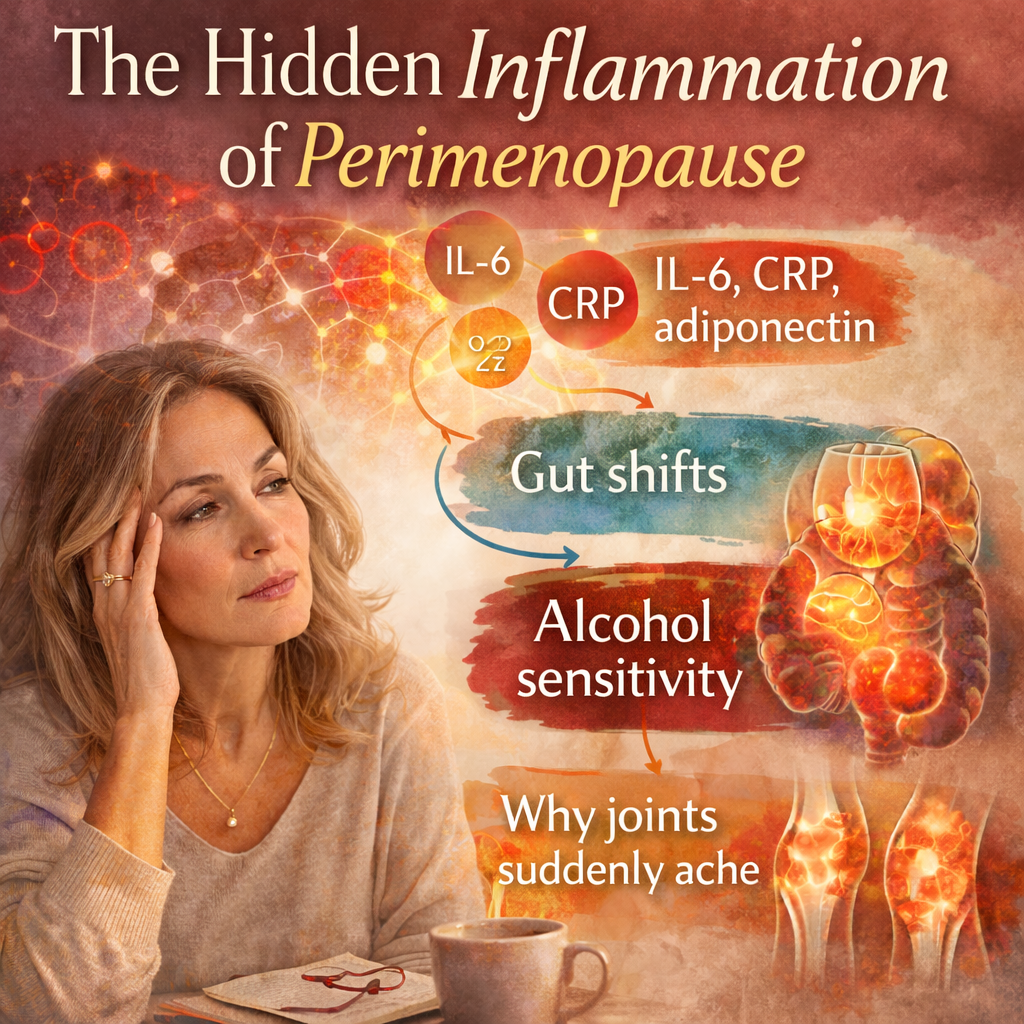
Perimenopause is, fundamentally, an inflammatory event.
In this article, we are going to look under the hood of your cellular health. We will explore the specific inflammatory markers—IL-6, CRP, and adiponectin—that spike during perimenopause. We will uncover the profound shifts happening in your gut microbiome, explain why your body suddenly rejects alcohol, and finally solve the mystery of why your joints ache for no apparent reason. Most importantly, we will discuss how to cool the fire.
The Science of “Inflammaging”: IL-6, CRP, and Adiponectin
To understand why your entire body feels inflamed, we have to understand the protective role estrogen plays in the female immune system.
Before perimenopause, estradiol (the most potent form of estrogen) acts as a master anti-inflammatory agent. It keeps your immune system balanced, preventing it from overreacting to everyday stressors. It essentially acts as a cool, calming blanket over your cellular function.
When estrogen levels begin to fluctuate erratically and eventually decline during perimenopause, that protective blanket is pulled away. Without estrogen to keep it in check, the immune system becomes hyper-reactive. This triggers a low-grade, chronic inflammatory state across the entire body—a process researchers have aptly coined “inflammaging.”
To see this in action, we only need to look at three specific biomarkers that drastically shift during the perimenopausal transition:
1. Interleukin-6 (IL-6) IL-6 is a cytokine, a type of protein that acts as a messenger in the immune system. When the body detects an injury or infection, it releases IL-6 to trigger an inflammatory response to heal the area. However, when estrogen drops, the body begins overproducing IL-6 even when there is no injury. High levels of IL-6 are directly linked to bone loss, muscle wasting, fatigue, and the sensation of overall physical pain.
2. C-Reactive Protein (CRP) CRP is a protein produced by the liver in response to inflammation. It is one of the primary markers doctors use to test for systemic inflammation and cardiovascular risk. Studies show that as women transition through perimenopause, their baseline CRP levels naturally rise. This circulating inflammation is what makes you feel puffy, sluggish, and generally unwell.+1
3. Adiponectin Adiponectin is a highly beneficial hormone secreted by your fat cells. Its job is to regulate glucose levels and break down fatty acids. Crucially, adiponectin is fiercely anti-inflammatory. As estrogen falls, adiponectin levels plummet. This double hit—rising inflammatory markers (IL-6 and CRP) combined with the loss of anti-inflammatory protectors (adiponectin)—creates a perfect storm. It alters how your body stores fat, driving the accumulation of visceral belly fat, which in turn produces even more inflammatory cytokines. It is a vicious, frustrating cycle.+3
The Estrobolome: Massive Shifts in Your Gut
If you feel like your digestion has completely changed—if foods you used to tolerate perfectly now cause severe bloating, gas, or discomfort—you are not imagining it. The inflammation of perimenopause is deeply intertwined with your gut health.
Within your gut microbiome lies a specialized collection of bacteria known as the estrobolome. The estrobolome is responsible for metabolizing and modulating the body’s circulating estrogen. When your estrogen levels drop, the diversity and health of your gut bacteria take a massive hit.+2
This loss of bacterial diversity leads to intestinal permeability, commonly known as “leaky gut.” The tight junctions that line your intestinal wall begin to loosen. Endotoxins (toxins produced by bacteria) and undigested food particles slip through these loosened junctions and enter your bloodstream.+1
Your immune system recognizes these particles as foreign invaders and mounts an attack, creating—you guessed it—more systemic inflammation. This gut-driven inflammation can manifest as sudden food sensitivities, irritable bowel symptoms, skin issues like rosacea or eczema, and profound brain fog. Healing the midlife body almost always requires starting with the gut.
The New Normal: Why You Are Suddenly Sensitive to Alcohol
Many women in their forties and fifties are shocked to discover that their relationship with alcohol changes overnight. A single glass of wine, which used to be a relaxing evening ritual, suddenly results in a racing heart at 2:00 AM, a brutal night sweat, and joints that ache for two days afterward.
Why does this happen? The answer lies in the intersection of liver function, histamine, and inflammation.
Alcohol is, by its very nature, an inflammatory toxin. In your twenties and thirties, your liver had the bandwidth and the enzymatic power to process this toxin relatively quickly. But during perimenopause, your liver is working overtime. It is desperately trying to process and clear the chaotic fluctuations of hormones. When you introduce alcohol, the liver immediately drops everything else to metabolize the booze. This leads to a backlog of circulating hormones and toxins, driving up inflammation.+1
Furthermore, many types of alcohol (particularly red wine and craft beers) are high in histamines. Estrogen and histamine have a bidirectional relationship: high estrogen drives up histamine, and high histamine drives up estrogen.But even as estrogen drops, the inflammatory environment of perimenopause makes women highly sensitive to histamines. You lack the enzymes to break them down efficiently. The result? A massive inflammatory flush, disrupted sleep architecture, and a central nervous system that feels like it has been plugged into a high-voltage socket.+2
“Why Do I Feel 80?”: The Mystery of Aching Joints
Of all the symptoms of perimenopausal inflammation, joint pain (arthralgia) is perhaps the most surprising and debilitating. Over half of all women going through menopause report a sudden onset of joint stiffness, particularly in the mornings. It typically strikes the knees, hips, hands, and shoulders.
If you have found yourself wincing as you walk down the stairs, it is crucial to understand that you haven’t suddenly developed severe osteoarthritis overnight. It is an inflammatory issue driven by hormone loss.
Estrogen is essential for maintaining the health of your joints in several ways:
- Cartilage Protection: Estrogen protects the chondrocytes (the cells that maintain cartilage). Without it, cartilage begins to degrade more rapidly.
- Lubrication: Estrogen regulates fluid levels throughout the body. When it drops, the synovial fluid that lubricates your joints dries up, leading to friction and stiffness.
- Targeted Inflammation: Remember IL-6? When the immune system becomes hyper-reactive due to low estrogen, inflammatory cytokines often settle in the synovial capsule (the lining of the joints).
Your immune system is essentially throwing a localized inflammatory tantrum inside your knees and knuckles. It is a biological fire that makes movement feel laborious and painful.
Cooling the Fire: Actionable Steps to Lower Inflammation
Understanding the hidden inflammation of perimenopause can feel overwhelming, but it should actually be incredibly validating. Your body is not failing you; it is reacting exactly as biology dictates to a loss of its master anti-inflammatory hormone.
The good news is that while you cannot stop the perimenopausal transition, you have immense power to cool the inflammatory fire.
1. Anti-Inflammatory Nutrition: Shift your focus toward a diet rich in antioxidants and healthy fats. Omega-3 fatty acids (found in wild-caught salmon, chia seeds, and high-quality fish oil supplements) are potent inhibitors of IL-6 and CRP. Dramatically reduce refined sugars and ultra-processed seed oils, which act like gasoline on the inflammatory fire in your gut.
2. Support the Estrobolome: Rebuild your gut diversity by incorporating prebiotics (garlic, onions, asparagus) and probiotics (kimchi, sauerkraut, kefir). Consider a high-quality probiotic supplement tailored for women’s health to help tighten the junctions in your gut lining and stop metabolic endotoxemia in its tracks.
3. Strategic Movement: While high-intensity, joint-pounding workouts might have worked in your thirties, they can actually spike cortisol and drive up inflammation in midlife. Shift your focus to heavy strength training (which improves insulin sensitivity and bone density) paired with restorative movement like yoga, Pilates, and walking to lubricate the joints without overburdening the nervous system.
4. Consider Hormone Therapy: For many women, Menopausal Hormone Therapy (MHT/HRT) is the most direct way to extinguish the fire. By replacing the estrogen your body is missing, you can quiet the hyper-reactive immune system, lower IL-6 and CRP levels, and restore lubrication to your joints. Always discuss the risks and benefits of hormone therapy with a menopause-literate healthcare provider.
5. Re-evaluate Your Relationship with Alcohol: Listen to your body. If alcohol is triggering joint pain, sleep disruption, and anxiety, it is time to take a step back. Explore the booming world of functional, non-alcoholic beverages that support your nervous system rather than taxing your liver.
You Don’t Have to Live in Pain
The narrative that midlife simply means learning to live with pain, bloat, and exhaustion is outdated and unacceptable. You are navigating a profound physiological transition, but inflammation does not have to be your permanent baseline. By understanding the science of your shifting hormones and taking targeted steps to support your gut, your immune system, and your liver, you can drastically reduce the inflammation and reclaim your vitality.
Are you ready to stop feeling inflamed, exhausted, and uncomfortable in your own body? Understanding your unique hormonal and inflammatory profile is the first step toward feeling like yourself again. Let’s work together to create a targeted, holistic plan to cool the fire and support your body through this transition.
FAQ: Perimenopause, Inflammation, and Joint Pain
Q: Is menopausal joint pain permanent, or will it go away? A: For many women, hormonally-driven joint pain (arthralgia) peaks during the late stages of perimenopause and early menopause when hormone fluctuations are most chaotic. Once hormones stabilize post-menopause, the pain often improves. However, actively managing inflammation through diet, movement, and potentially hormone therapy is crucial to prevent long-term joint damage.
Q: Can a blood test tell me if my inflammation is from perimenopause? A: A doctor can test your levels of hs-CRP (high-sensitivity C-Reactive Protein) to check for systemic inflammation, as well as test your hormone levels (like FSH and Estradiol). While there isn’t one single test that says “this inflammation is 100% perimenopause,” high CRP coupled with a woman’s age and symptom profile strongly indicates hormonally-driven inflammaging.
Q: Why do I feel so much more inflamed when I am stressed? A: Stress causes the adrenal glands to release cortisol.While cortisol is naturally anti-inflammatory in short bursts, chronic high cortisol causes the tissues to become resistant to it. Once cortisol resistance occurs, the immune system goes unchecked, leading to a massive spike in inflammatory cytokines. Managing stress is not a luxury in midlife; it is a vital biological necessity.+2
Q: Are there specific supplements that help with midlife joint pain? A: Yes! High-quality Omega-3 fatty acids (EPA and DHA) are excellent for joint lubrication and lowering inflammation. Curcumin (the active compound in turmeric) is a powerful natural anti-inflammatory that has been shown in studies to be as effective as some NSAIDs for joint pain.Additionally, collagen peptides can help support the integrity of joint cartilage. Always consult your doctor before starting new supplements.+1
Q: Do I have to give up alcohol entirely? A: Not necessarily, but you may need to change your habits. Many women find they can tolerate clear liquors (like vodka or tequila) better than histamine-rich wines or heavy beers. However, if your inflammation and sleep disruption are severe, taking a prolonged break from alcohol is one of the fastest ways to let your liver clear out toxins and reduce systemic inflammation.