
By Suzanne Elkind | www.suzanneelkind.com
There is a pervasive and incredibly damaging myth in our culture that menopause marks the end of a woman’s sexual vitality. Society often paints a picture of midlife as a time when intimacy is packed away in a dusty box, relegated to a thing of the past. So, when you find yourself in your forties or fifties with a sex drive that has seemingly vanished into thin air, it is easy to internalize that myth. You might look at your partner and feel a confusing mix of guilt, frustration, and a profound sense of loss.
You might be asking yourself, “Is this just how it is now? Am I broken?”
Let’s dismantle that narrative right now. You are not broken, and a vibrant sex life absolutely does not have to end at menopause.
However, your body and your brain are going through a massive, systemic transition. When women complain to their doctors about low libido during perimenopause and menopause, the conversation usually starts—and stops—with estrogen. While estrogen is a vital piece of the puzzle, treating it as the only piece is a massive oversimplification of female sexual health.
Female desire is arguably one of the most complex physiological and psychological processes in the human body. It is a delicate symphony of hormones, neurotransmitters, emotional connection, and physical well-being. When the music stops, we have to look at the entire orchestra.
In this article, we are going to look beyond estrogen. We will explore the critical roles of dopamine and testosterone, the profound difference between vaginal and central arousal, and the ways sleep deprivation and relationship stress act as silent libido killers.
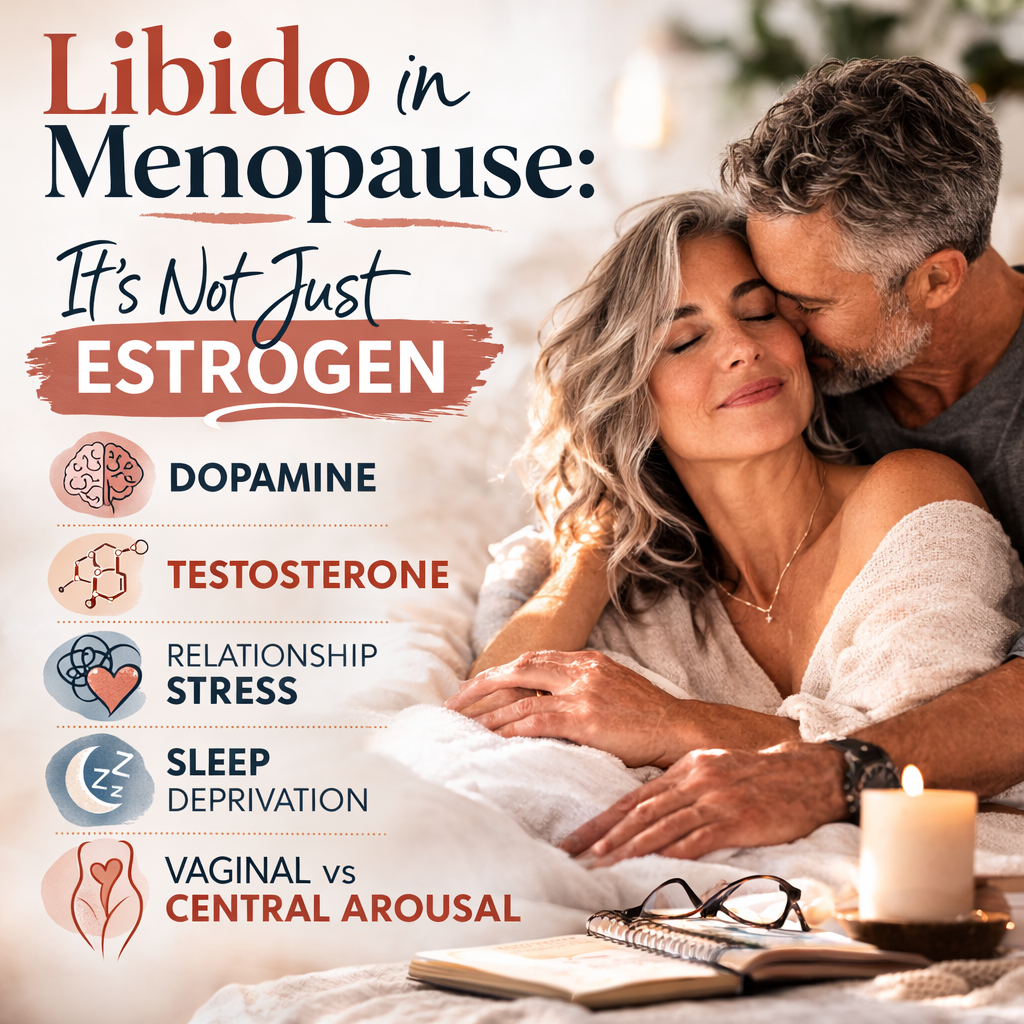
The Missing Hormone: Testosterone and Female Desire
When we hear “testosterone,” we almost exclusively think of men. But testosterone is not just a male hormone; it is the most abundant active sex hormone in the female body throughout a woman’s reproductive years.
While estrogen is responsible for maintaining the health, elasticity, and lubrication of the vaginal tissues (the physical mechanics of sex), testosterone is the fuel for your actual drive. It is the hormone of vitality, motivation, and spontaneous sexual desire. It is what makes you suddenly think about sex in the middle of a Tuesday afternoon.
Unlike estrogen, which drops precipitously during perimenopause, testosterone levels begin a slow, steady decline starting in your late twenties or early thirties. By the time a woman reaches menopause, her testosterone levels are often half of what they were in her twenties. For many women, this gradual decline goes unnoticed until the dramatic drop in estrogen compounds the issue. Suddenly, the physical discomfort of low estrogen (vaginal dryness) meets the psychological apathy of low testosterone, resulting in a completely flatlined libido.
If you feel like the physical “hardware” is mostly working, but the “software” program for desire has been deleted from your hard drive, a decline in testosterone is highly likely playing a starring role.
The Brain’s Reward System: Dopamine and Anticipation
Desire does not start in the pelvis; it starts between your ears. The brain is your most powerful sex organ, and it relies heavily on neurotransmitters to signal arousal. The most critical of these is dopamine.
Dopamine is often called the “feel-good” neurotransmitter, but more accurately, it is the molecule of motivation and anticipation. It is the chemical that makes you want to pursue a reward. In the context of sex, dopamine is what makes the buildup—the flirting, the anticipation of touch, the mental fantasy—feel exciting and compelling.
Here is where the midlife transition creates a perfect storm: Estrogen and dopamine are best friends. Healthy estrogen levels help stimulate dopamine production in the brain. When estrogen wildly fluctuates and eventually plummets during menopause, dopamine levels often follow suit.+1
This drop in dopamine is the root of menopausal brain fog, lack of focus, and general apathy. It is also a primary reason why you might lose interest in sex. Without sufficient dopamine, the brain’s reward center simply isn’t activated by the thought of intimacy. The anticipation is gone. Sex feels like just another chore on an already overflowing to-do list, rather than a pleasurable experience to pursue.
The Anatomy of Desire: Vaginal vs. Central Arousal
To truly understand midlife libido, we have to separate physical readiness from psychological desire. This brings us to the crucial distinction between vaginal arousal and central arousal.
- Vaginal Arousal (The Body): This is the localized, physical response to sexual stimulation. It involves increased blood flow to the genitals, engorgement, and lubrication. This process is heavily dependent on healthy estrogen levels to keep the tissues resilient and responsive.+1
- Central Arousal (The Brain): This is the psychological experience of feeling “turned on.” It is the mental engagement, the erotic focus, and the subjective feeling of desire. This is driven by dopamine, testosterone, and your emotional state.
In our twenties, central and vaginal arousal usually happen simultaneously. You feel mentally turned on, and your body instantly follows suit. But in midlife, these two systems can become entirely disconnected.
You might experience central arousal—you genuinely want to be intimate with your partner, and your brain is engaged—but due to low estrogen, your body does not respond with lubrication or engorgement, leading to painful sex.
Conversely, and incredibly commonly, you might experience physical, vaginal arousal in response to your partner’s touch, but experience zero central arousal. Your body is technically ready, but your brain is completely disengaged, thinking about tomorrow’s grocery list or a work email.
Understanding this disconnect is vital. It shifts the paradigm from spontaneous desire (feeling horny out of nowhere) to responsive desire. In midlife, you often have to start the physical engine to get the mental engine running. Acknowledging that your body and brain need different types of warm-up time can remove a massive amount of pressure from your intimate life.
The Silent Killers: Sleep Deprivation and Fatigue
You cannot talk about libido without talking about energy. And in midlife, energy is often the very first thing to go.
Perimenopause is notoriously disruptive to sleep. Fluctuating hormones cause night sweats that jolt you awake, while dipping progesterone (our natural relaxing hormone) leads to insomnia and middle-of-the-night anxiety.
When you are chronically sleep-deprived, your body enters a state of survival. Your adrenal glands pump out cortisol (the stress hormone) to keep you upright and functioning. Biologically speaking, reproduction and sexual pleasure are considered “luxuries” by the body. If your central nervous system believes you are in a high-stress survival situation—which is exactly what chronic exhaustion signals—it will completely shut down non-essential functions like libido.
If you are exhausted down to your bones, struggling to make it through the workday, and crashing on the couch by 8:00 PM, your lack of sex drive isn’t a mystery. It is a highly intelligent biological adaptation. Your body is demanding rest, not exertion. Prioritizing sleep hygiene, managing night sweats, and regulating your nervous system must happen before the libido can return.
The Emotional Load: Relationship Stress and Resentment
Finally, we have to look at the environment in which your libido is trying to survive. Hormones and neurotransmitters operate within the context of your real, daily life.
Midlife is often referred to as the “sandwich generation.” You might be managing the intense demands of raising teenagers while simultaneously caring for aging parents. You are likely at the peak of your career responsibilities. The mental load and invisible labor women carry during this decade are staggering.
If the division of labor in your relationship feels wildly unequal, or if there is unresolved conflict and poor communication, true central arousal is nearly impossible. Resentment is the ultimate libido killer. The brain cannot relax into pleasure, vulnerability, and eroticism with someone you are quietly frustrated with all day long.
Furthermore, as our bodies change in midlife, so does our body image. If you are feeling uncomfortable in your own skin, grieving the loss of your younger physique, or feeling disconnected from your physical self, it is incredibly difficult to share that self intimately with a partner. Cultivating a renewed emotional connection—both with your partner and with yourself—is a foundational step in bringing your sex drive back online.
Reclaiming Your Vitality
Losing your libido in midlife is common, but it does not have to be permanent. It is a signal that your body, your brain, or your relationship is asking for a different kind of attention.
Addressing this requires a holistic approach. It means speaking with a knowledgeable healthcare provider about hormone optimization—not just estrogen, but potentially testosterone therapy and vaginal DHEA. It means actively supporting your dopamine levels through novel experiences, exercise, and proper nutrition. It means prioritizing your sleep with fierce boundaries. And importantly, it means having honest, courageous conversations with your partner about changing dynamics, reducing relationship stress, and exploring what pleasure looks like for you now, rather than what it looked like twenty years ago.
You have the right to a vibrant, joyful, and connected intimate life at every age. It is not gone forever; it simply requires a new roadmap.
Navigating the intersection of midlife hormones, identity, and intimacy is a deeply personal journey, but you don’t have to walk it alone. If you are ready to address the root causes of your burnout, clear the brain fog, and reconnect with your vitality, we can map out a plan together.
FAQ: Midlife Libido, Hormones, and Intimacy
Q: Is it normal to have absolutely zero interest in sex during perimenopause? A: Yes, it is incredibly common. The dramatic shifts in estrogen and testosterone, combined with the drop in dopamine, sleep deprivation, and the high stress of midlife, create a perfect storm that essentially turns off the brain’s desire center. It is a normal physiological response, but it is also something that can be addressed and improved.
Q: What is the difference between spontaneous and responsive desire? A: Spontaneous desire is wanting sex out of the blue, before any physical touch or stimulation occurs (highly driven by testosterone). Responsive desire means your brain needs physical touch, emotional connection, or a relaxed environment first in order to get turned on. Many women shift from spontaneous to responsive desire in midlife.
Q: I have vaginal dryness, but my doctor only mentioned lubricants. Is there anything else? A: While lubricants are helpful for the act of sex, they do not fix the underlying tissue changes. Vaginal estrogen (creams, rings, or suppositories) or vaginal DHEA are localized hormone treatments that actually restore the thickness, elasticity, and natural lubrication of the vaginal tissue without heavily impacting systemic hormone levels.
Q: Can I take testosterone if I’m a woman? A: Yes. While testosterone therapy is not FDA-approved specifically for female sexual dysfunction in all countries, many specialized menopause practitioners prescribe it off-label to treat Hypoactive Sexual Desire Disorder (HSDD) in midlife women. It is carefully dosed to match female physiological levels and can be a game-changer for libido.
Q: How do I talk to my partner about this without hurting their feelings? A: Start by separating the biology from the relationship. Explain that your lack of drive is a neurological and hormonal shift, not a reflection of your attraction to them. Use “I” statements, such as: “I am struggling with my energy and my hormones right now, and my body feels different. I still love you and want to stay connected, but I need us to figure out a new way to approach intimacy while I navigate this.”