
By Suzanne Elkind | www.suzanneelkind.com
It usually starts with a whisper, a subtle shift that you can’t quite put your finger on. You walk into a room and completely forget why you are there. You find yourself staring at a computer screen, unable to muster the focus to begin a task you’ve done a hundred times before. You lose your train of thought mid-sentence, grasping for a word that is stubbornly hovering just out of reach. Or perhaps you look at your meticulously organized calendar—the very tool that has kept your life running smoothly for decades—and feel completely overwhelmed, paralyzed by the sheer weight of executive function.
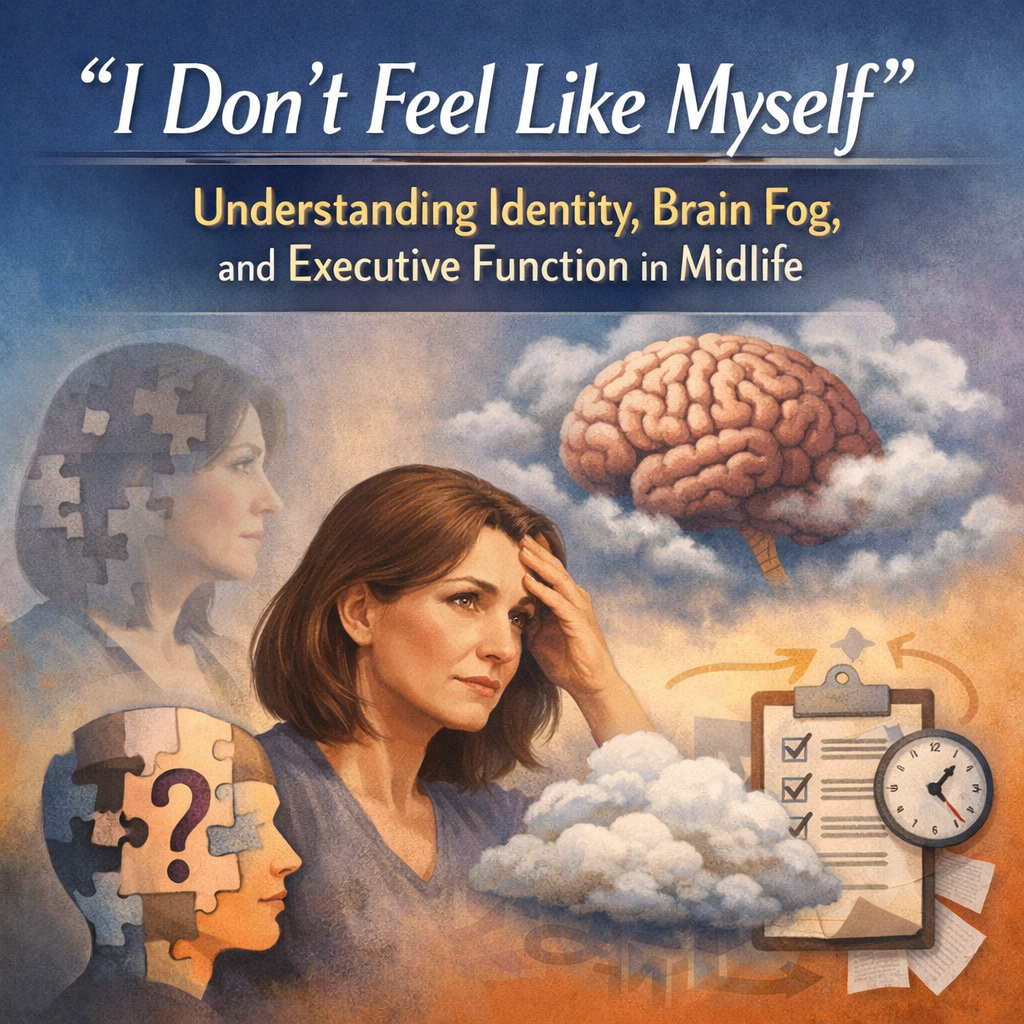
Eventually, the whisper becomes a loud, undeniable realization: “I just don’t feel like myself.”
For many women, midlife brings an unexpected and disorienting cognitive shift. It is a season where the brain feels as though it is wading through molasses. The quick-witted, organized, multi-tasking version of yourself seems to have vanished, replaced by someone who is chronically fatigued, easily distracted, and struggling to keep all the plates spinning.
If this sounds familiar, take a deep breath. You are not alone, and more importantly, you are not losing your mind. What you are experiencing is a profound, biologically driven neurological transition.
In this article, we will explore the intersection of identity, brain fog, and executive function in midlife. We will unpack the science behind estrogen and cognition, discuss why ADHD is frequently unmasked during perimenopause, delve into the hopeful science of neuroplasticity, and outline the supplements that actually support brain health during this pivotal time.
The Hormone-Brain Connection: Estrogen and Cognition
To understand why your brain feels different, we must first look at what is happening beneath the surface. For decades, the medical community largely framed perimenopause and menopause as exclusively reproductive transitions, focusing on hot flashes, night sweats, and the cessation of menstruation. However, modern neuroscience tells a very different story: menopause is fundamentally a neurological transition.
Your brain is incredibly rich in estrogen receptors. They are densely packed in areas responsible for memory, learning, and executive function—most notably the hippocampus and the prefrontal cortex. Estrogen is a “master regulator” in the female brain. It helps neurons communicate effectively, promotes the growth of new neural connections, and regulates the brain’s use of glucose, which is its primary fuel source.
In short, estrogen keeps your brain energized and sharp.
During perimenopause, estrogen levels do not just gently decline; they fluctuate wildly. One day your estrogen might be sky-high, and the next it might be nearly undetectable. This erratic hormonal rollercoaster creates a literal energy crisis in the brain. Because your brain has come to rely on estrogen to help it metabolize glucose, a sudden drop in estrogen leaves your neurons struggling for fuel.
This cerebral energy crisis is the primary driver behind midlife brain fog. It explains why you struggle with word retrieval, why your short-term memory feels like a sieve, and why complex problem-solving suddenly feels exhausting. Your brain is temporarily starved of the energy it needs to function at its usual high capacity.
The Perfect Storm: ADHD Unmasked in Perimenopause
One of the most profound and least discussed phenomena of midlife is the sudden collapse of executive function, often leading to a late-in-life diagnosis of Attention Deficit Hyperactivity Disorder (ADHD).
How does a woman make it to 40 or 50 without realizing she has ADHD, only to have it “appear” in midlife? The answer, once again, lies in the intricate dance between hormones and neurotransmitters.
Estrogen is deeply intertwined with dopamine and serotonin—the neurotransmitters responsible for focus, motivation, reward, and mood regulation. Estrogen helps stimulate the production of dopamine and delays its breakdown in the brain. For women who have undiagnosed, mild, or moderate ADHD, the robust estrogen levels of their 20s and 30s essentially act as a natural medication. The estrogen boosts their dopamine just enough to help them compensate, mask their symptoms, and develop highly effective coping strategies (like extreme organization, perfectionism, or relying on adrenaline to meet deadlines).
However, when perimenopause hits and estrogen levels begin their chaotic decline, that structural support is kicked out from underneath them. As estrogen plummets, dopamine levels plummet alongside it.
Suddenly, the coping mechanisms that worked for decades fail. The “scaffolding” collapses.
Women in this stage often describe feeling a profound loss of executive function. They can no longer initiate tasks, prioritize their workload, regulate their emotions, or manage their time. The mask falls off, and the underlying neurodivergence is fully exposed. This is why we are seeing a massive surge in women in their 40s and 50s seeking ADHD assessments. If you have found yourself suddenly unable to manage the administrative load of your life, it is not a moral failing or a sign of laziness—it may be that perimenopause has unmasked a neurobiological reality that was there all along.
You Are Not “Losing Your Mind”: Navigating the Identity Shift
When you can no longer rely on your brain to perform the way it always has, it deeply impacts your sense of self. Many women build their identities around their capability—their ability to remember every detail, organize the household, excel in their careers, and effortlessly multitask. When those abilities falter, it triggers an existential crisis. If I am no longer the woman who can do it all, who am I?
It is incredibly common to feel a sense of grief for the brain you used to have. You might feel frightened, wondering if this brain fog is an early sign of dementia (a fear exacerbated by the fact that the symptoms of perimenopause and early cognitive decline can look frighteningly similar on the surface). You might face dismissal from medical professionals who wave away your concerns as “just stress” or prescribe antidepressants without addressing the underlying hormonal or neurological shifts.
Let this serve as your validation: You are not losing your mind. The changes you are experiencing are real, measurable, and biological. Your distress is a normal reaction to an intensely disorienting phase of life. Acknowledging this is the first step toward redefining your identity. Midlife is not about forcing yourself to return to who you were in your thirties. It is about grieving the loss of your old coping mechanisms, extending radical self-compassion to your current state, and actively supporting your brain as it remodels itself for the next half of your life.
The Power of Neuroplasticity: Remodeling the Brain
While the narrative around the midlife brain can feel incredibly bleak, there is a tremendous amount of hope, and it is rooted in neuroplasticity.
Neuroplasticity is the brain’s remarkable ability to reorganize itself by forming new neural connections throughout life. For a long time, scientists believed that the brain’s structure was fixed after early adulthood. We now know that the brain remains dynamic and adaptable until our final days.
During perimenopause, your brain is undergoing a massive remodeling process. It is adapting to a lower-estrogen environment. While this transition phase is rocky and uncomfortable, the brain does eventually stabilize. Research shows that post-menopausal women often see a return of their cognitive clarity once their brains have adapted to their new hormonal baseline.
Even better, you can actively encourage positive neuroplasticity to support your brain during this transition. How?
- Novelty and Learning: The brain thrives on new challenges. Learning a new language, taking up a complex hobby, or even taking a different route to work forces the brain to forge new neural pathways, strengthening its overall resilience.
- Physical Movement: Exercise is one of the most powerful triggers for neuroplasticity. Aerobic exercise increases the size of the hippocampus and boosts the production of Brain-Derived Neurotrophic Factor (BDNF), a protein that acts like fertilizer for your brain cells.
- Stress Reduction: Chronic stress and high cortisol levels are toxic to the brain, actively shrinking the hippocampus and impairing executive function. Practices like mindfulness, meditation, and deep sleep are not just “self-care”—they are vital neurological interventions that protect your brain’s plasticity.
Supplements That Actually Help Support Executive Function and Clarity
While lifestyle changes are the foundation of cognitive health, targeted supplementation can provide the extra support your brain needs during the perimenopausal transition. Note: Always consult with your healthcare provider before starting any new supplement regimen, as individual needs and contraindications vary.
Here are several evidence-based supplements that can help pierce through the brain fog and support executive function:
1. Omega-3 Fatty Acids (EPA and DHA) Your brain is nearly 60% fat, and much of that is made up of Omega-3 fatty acids. DHA is essential for the structural integrity of brain cells, while EPA is a potent anti-inflammatory. High-quality Omega-3 supplements can help reduce neuroinflammation (a major contributor to brain fog) and support neurotransmitter function.
2. Magnesium L-Threonate Magnesium is involved in over 300 biochemical reactions in the body, but most forms of magnesium do not easily cross the blood-brain barrier. Magnesium L-Threonate is a highly absorbable form specifically designed to enter the brain. Studies suggest it can enhance learning, memory, and cognitive function by increasing the density of synapses. It is also excellent for calming an overactive nervous system.
3. Creatine Monohydrate Traditionally known as a sports supplement for muscle growth, creatine is emerging as a powerhouse for brain health. Remember the cerebral energy crisis caused by fluctuating estrogen? Creatine helps supply energy directly to brain cells. Supplementing with 3-5 grams of creatine daily has been shown to improve working memory, reduce mental fatigue, and support overall executive function, particularly in women.
4. B-Complex Vitamins (Especially B6, B9, and B12) B vitamins are essential for energy production and the synthesis of neurotransmitters like dopamine and serotonin. Vitamin B12 deficiency is common in midlife and can mimic symptoms of dementia, causing severe memory loss and confusion. A high-quality, methylated B-complex can support sustained mental energy and emotional regulation.
5. Vitamin D3 Vitamin D functions more like a hormone than a vitamin in the body, and there are Vitamin D receptors located throughout the brain. Low levels are strongly linked to cognitive impairment, mood disorders, and brain fog. Ensuring your Vitamin D levels are optimal (ideally through blood testing) is a simple but critical step in protecting your cognitive health.
6. L-Theanine Found naturally in green tea, L-Theanine is an amino acid that promotes a state of “calm focus.” It increases alpha brain waves, which are associated with relaxation without drowsiness. For the midlife woman struggling with the chaotic, overwhelming symptoms of unmasked ADHD or anxiety-induced brain fog, L-Theanine can help quiet the mental static and improve attention.
Embracing the Next Chapter
The transition through midlife is not a sign of decline; it is a profound biological remodeling. Feeling like you “don’t know who you are anymore” is a terrifying, frustrating, but entirely normal part of this process. By understanding the underlying biology—how estrogen impacts your brain, why executive function falters, and how your neurochemistry is shifting—you can replace fear with self-compassion.
You are not broken. You are transitioning. With the right support, validation, lifestyle adjustments, and targeted interventions, the fog will lift. You will find yourself again—perhaps not the exact same self you were in your thirties, but a wiser, more resilient, and deeply grounded version of yourself, ready for the chapters ahead.
Ready to reclaim your clarity, process these life transitions, and rebuild your executive function? You don’t have to navigate this neurobiological shift alone. Partner with a professional who understands the unique intersection of midlife, identity, and cognitive health.
FAQ: Midlife Brain Fog, ADHD, and Executive Function
Q: What exactly does perimenopause brain fog feel like? A: Brain fog is not a medical diagnosis, but a cluster of symptoms. Women typically describe it as a feeling of mental cloudiness or sluggishness. Common experiences include walking into a room and forgetting why, forgetting common words mid-sentence, losing your train of thought, struggling to multitask, and feeling mentally exhausted after performing tasks that used to be easy.
Q: Can perimenopause actually cause ADHD? A: Perimenopause does not cause ADHD, as ADHD is a neurodevelopmental condition you are born with. However, the drop in estrogen (and consequently, dopamine) during perimenopause can severely exacerbate ADHD symptoms or unmask mild ADHD that a woman previously managed to hide through coping mechanisms. This is why many women receive their first ADHD diagnosis in their 40s or 50s.
Q: Will my brain ever go back to normal after menopause? A: Research indicates that the brain fog experienced during perimenopause is generally temporary. The brain is going through a massive transition and experiencing an energy crisis as it adapts to operating with less estrogen. Once you reach post-menopause and your hormones stabilize at their new baseline, the brain usually adapts, and many women report that the “cloud” lifts and their cognitive clarity returns.
Q: Is Hormone Replacement Therapy (HRT) a cure for brain fog? A: For many women, HRT (specifically estrogen therapy) can be highly effective in resolving brain fog, as it directly addresses the hormonal fluctuations causing the brain’s energy crisis. However, HRT is not a magic bullet and is not suitable for everyone. It is best used as part of a comprehensive approach that includes lifestyle changes, nutrition, and mental health support.
Q: What is the most important thing I can do right now to support my executive function? A: Prioritize sleep and stress management. Sleep is when your brain clears out metabolic waste and consolidates memories. Chronic stress raises cortisol, which actively damages the areas of the brain responsible for executive function. Protect your rest fiercely, lower your expectations of what “doing it all” looks like, and consider targeted supplements like Omega-3s or Creatine to support brain energy.